
I enjoyed talking about my book, Being Human Is Hard: Choose Forgiveness, with Blake Joseph on the KEVN Morning Show. Click below to view.

I enjoyed talking about my book, Being Human Is Hard: Choose Forgiveness, with Blake Joseph on the KEVN Morning Show. Click below to view.

Do you ever find yourself raging at God? “Why am I being punished? Why did you send a horrible virus to plague us? Why am I suffering more than others?” If so, you’re not alone.
Psychologists have identified three main types of forgiveness:
forgiveness of self, forgiveness of others,
and forgiveness of God or Fate.
We may feel we are being unfairly hurt or controlled by whatever power created our crazy world. We can’t understand it all. Why do bad things happen to good people? Why are we plagued with disabilities, genetic disorders, cancers? Why are there hurricanes, floods, earthquakes? Why do some people have to die young? Why do we have to die at all?
So many questions and unfortunately I can’t provide you with certain answers. And that can lead us to another question: Why can’t there be more certainty in this ever-changing world we live in?
Most of us tend to be on the impatient side, desiring definite answers as quickly as possible. We want solid reasons for our suffering, and we don’t want to wait and see what good things might result from our pain. Pain is bad and we want it to stop. It takes an upshift in our thinking to consider whether maybe, just maybe, some pain and uncertainty could actually have benefits.
Even though I don’t like to suffer, I do know, for certain, that I have learned from my suffering. That it has pushed me forward and helped me grow. I know I wouldn’t want to be the person I was before my pain because that person was not as strong, caring, and wise as the person I am now – and as the person I hope someday to be.
So how do we cope when suffering and tragedy appear in our lives? There’s a reason the Serenity Prayer, written by Reinhold Niebuhr, is so popular. It’s great advice.

The serenity prayer reminds me that there are going to be things in my life I won’t like and won’t be able to change. If I desire serenity, I am going to need to accept the fact that sometimes I am not going to get my way and I need to realize that can be a good thing.
Once I accept what is,
I can quit expending my energy fighting to bring back what isn’t.
Instead of scolding God, I can accept that I am not a god – not even close – and I don’t always know what’s best. Accomplishing that will give me the serenity the prayer speaks of, which will provide me with the courage to do something good when a nasty virus comes calling or a hurricane blows in. I can start creating a new path based on acceptance of those things I can’t change.
I’ve had the opportunity to read and teach a lot of world history. That has helped me accept the fact that life involves pain and struggle. Not just for me. For everyone.
My background has made me realistic about how hard it is to be human, but it hasn’t made me hopeless. One of the gods of the Hindu triumvirate, Shiva, is known as “The Destroyer.” When I first learned of that I was dismayed and couldn’t imagine why you’d worship a god of destruction. I soon learned destruction wasn’t what the god was all about.
Destruction is a necessary step on the path to transformation,
comparable to tearing down a dilapidated, crumbling building
so that a new, improved structure can take its place.
Shiva actually symbolizes hope as the god creates, protects, and transforms the universe. Shiva’s purpose is to destroy that which needs changing so that something new and better can be created. What was has served its purpose. It’s time to generate something new. The Hindu religion began thousands of years ago in Asia, and then, just as now, humans had to accept shocking events and develop a new normal, knowing the new normal would not last forever either.
Sometimes I get very excited about change and can maintain a positive attitude because I’m looking at the possibilities for good instead of the possibilities for pain. Sometimes I face the negative because I need to be thinking about how I can do things better and improve who I am. And sometimes I just get mad at God and grieve what was, wanting fervently to turn back time.
There are many things I don’t understand in life and my favorite description for the Divine, after Love, is the Great Mystery (Wakan Tanka in Lakota). When I’m feeling angry and anxious because life has gotten crazy and beyond what I can comprehend, my prayers may go something like this:
“Okay, God. I don’t appreciate all this. It’s awful. I’ve got lots of questions for you, but I’ll accept what happened. I guess I forgive you. You better help me out with this, though. I’m going to need you.”
I imagine God laughing and reassuring me, “I’m with you. We’ve got this. It’s going to be okay.”
So, after I grieve what was or what I thought would be,
When disaster strikes, my bottom line is – forgiveness is my best choice.

When will you choose to forgive?
Not now, I’m waiting.
What are you waiting for?
I’m waiting
For my former friend to change
To get even with my coworker
For my enemies to realize they are wrong
For my husband to stop drinking; then everything will be better
For my wife to ask for forgiveness; it was her fault
To feel capable; I have no idea how to deal with this
For courage. What if he gets mad? What if she turns against me?
For God to change things.
What if you don’t wait and choose forgiveness?
I will have to
have courage and confront my fears
take responsibility for my feelings
change the way I think
put forth effort
solve problems.
I won’t get to
be a victim anymore
be certain I’m right
pretend to be who I think I should be. I’ll have to be me.
What if you choose forgiveness and do the work necessary to forgive?
No more self-righteous anger
No more fear of faults, failures, and flaws
A better understanding of myself and others
Feelings of compassion instead of bitterness
Freedom from unrealistic expectations
Forward movement, no more circling backwards
Genuine, honest communication
A new and improved chapter in my life story
Peace
-Chris Heacock
Photo by Jeremy Bishop on Unsplash

I recently came upon an electronic letter I’d written my daughter 15 years ago in which I expressed my gratitude for gratitude. Although I’d read and heard messages about the power and importance of gratitude, I noted in the letter that I hadn’t really “gotten it.” I’d been spending way too much time worrying about the past and future, an activity that was stealing my joy – my appreciation for beautiful moments, acts of kindness, and loving relationships.
Worrying is different than preparing for the future. Worrying is about wishing what happened hadn’t happened and wishing what might happen won’t. It’s thinking about what has gone wrong and could go wrong instead of figuring out how to make amends for a past regret or planning for a better tomorrow. Planning is proactive and makes me feel hopeful. Worrying stifles hope and diverts me from my goals.
Forgiveness is about letting go of that stubborn desire for a different past, acknowledging “it is what it is,” and creating an innovative path forward. When I’m faced with a painful situation, I remind myself that I cannot hide from or deny my hurt and sadness. Life is not going according to Plan A and I must problem solve and craft a Plan B. But if all I feel is despair or anger, my ability to construct a new story is hampered by a lack of positive energy. I need to light the path ahead with the fuel I receive from gratitude.
Gratitude is a powerful force that can allow what is good and kind in our lives to break through the clouds of bitterness and regret. Gratitude clears out the negative thoughts that are blinding us to the beauty in life and possibilities for a bright future; a future in which we can let go of the excessive shame or anger that is harming our bodies and our souls.
Sometimes I’m just grateful that I missed a near car accident or caught myself before saying something really stupid. Simple things can fill me with gratitude, such as homemade chocolate chip cookies and cute animal videos. When I’m going through a tough time, I’m especially appreciative of nature. Hiking and biking on lovely trails, especially if it’s a sunny, warm day, fills me with awe and the awareness of a power greater than myself. Music calms and inspires me. I love singing, dancing, and playing the piano. Beautiful harmonies and the joining together of different instruments and voices lifts me up. I’m especially grateful for my connections with supportive people who guide me to my higher self and help me find peace.
When I’m hurting, I need hope. Why go through all that forgiveness work of understanding my pain, trying to be compassionate and kind, and finding a way to let go of what is burdening me if I believe it’s impossible? Gratitude helps me believe things can get better because I’ve opened my eyes to the goodness and beauty that life contains. There is darkness and there is light. They can exist at the same time, and the light will lead me through the darkness.
Taking time to be grateful is like a vacation from shame, regret, anger, and bitterness. Counting blessings instead of worries allows my mind to divert from a path going nowhere. It shines a new light on my fears and gives me fresh perspectives. I can create a story in which I overcome thoughts and emotions that are binding me to a bleak past. My story becomes one of optimism and transformation. And yours can be too.
-Chris Heacock
Photo by Luca Bravo on Unsplash

By Kevin C. Thornton, Walden University
As she stood before a group of women in Nakuru, Kenya, preparing to deliver a talk on forgiveness, Dr. Christy Heacock ’17 looked out and saw not just an eager audience but also a new horizon.
A lifelong high school and college educator, Heacock was pursuing a new challenge. Although she loved teaching and had experience in a range of subjects, she craved something different, something inspiring.
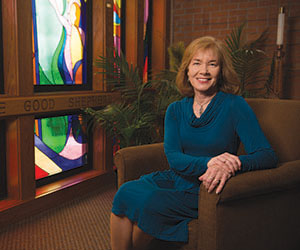
“It was a leap,” she says. “I gave up a stable and comfortable career because I wanted to expand, to learn something new and valuable.”
She chose to pursue her PhD in Psychology at Walden, eventually researching and writing her dissertation on forgiveness as experienced by people with different sacred beliefs.
Heacock interviewed people of diverse religious backgrounds—from the well-known religions of Christianity, Islam, and Buddhism to lesser-known faiths such as the Red Road and Sacred Pipe of the Lakota. Ultimately, what she learned was that forgiveness is universal. It can be a healing agent no matter your location or your spiritual roots.
But the proof was in the audience in front of her at a women’s center more than 8,000 miles from her home in the Black Hills of South Dakota. She was in Kenya as part of a church mission trip to provide eyewear to those who couldn’t afford it. Heacock saw things more clearly after that trip, too.
“Our team leader and the center director knew about my dissertation and asked me to speak to the women there. The director felt forgiveness would be important to their journeys,” she says. “They were all struggling to raise families and earn extra money through sewing and making craft items to sell. They were in difficult situations, many of which involved forgiveness issues.”
The presentation in Kenya was not the first or the last based on Heacock’s research. But it left an impression on her.
“My goal is to help people heal and move forward,” she says. “I felt like I connected with those women. It was a perfect example of how our problems are the same, no matter where we’re from. Forgiveness is an issue for everyone.”
The next steps on Heacock’s journey are to continue to perfect and deliver her forgiveness presentation, teach occasional courses, and pull her research and stories together into a book to increase understanding of the physical, mental, and spiritual healing power of forgiveness.
“Psychology is becoming more open to forgiveness because of its health benefits,” she adds. “I selected forgiveness as a focus because it can help people from diverse backgrounds better understand each other.
“I’ll keep teaching,” she says, “but I’ll also keep pursuing forgiveness as an agent for social change.”
Featured Image by Casey Horner on Unsplash
 Choose Forgiveness