Favorite Forgiveness Quotes

There is some good in the worst of us and some evil in the best of us.

When we discover this, we are less prone to hate our enemies.

~ Martin Luther King Jr.

It’s very easy to demonize people who hurt us and look at them as objects that cause harm, not imperfect humans who are hurting like us. We may put people in good and bad boxes, refusing to let them out, and ignore Bible verses like Luke 6:27 that say “Love your enemies, do good to those who hate you.” Remembering that we all struggle helps us forgive both others and ourselves.

Favorite Forgiveness Quotes

Your willingness to wrestle with your demons will cause your angels to sing.

~August Wilson

Forgiveness takes courage. Why? Because we must overcome shame and blame, and accept the things about ourselves and others that have caused pain. Struggling with our fears opens the door to our angels, who may be in human or spirit form, and who can help us overcome our darkness.

Favorite Forgiveness Quotes

I want to be remembered for my kindness, for showing up, for giving second chances, for acknowledging my own toxic traits and for loving selflessly. If that isn’t it, then I failed horribly. Remember to extend grace because we’re all just walking each other home.

~Happy Soul

It’s important to ask ourselves what kind of person we want to be. The peace that comes with forgiveness is based on being true to oneself. Many of us want to be forgiving, but our pride and egos stand in the way. We’re afraid to admit our faults and we don’t want to be softies who get taken advantage of. But forgiveness isn’t about excusing or condoning bad behavior. It’s about justice and mercy; the creation of a fearless spirit and a kind heart.

Why Can’t We All Just Get Along?

I’ve taught a variety of math and psychology courses to high school and college students over the years. Some people have been impressed that I teach math but unimpressed that I teach what they consider the trivial, common-sense subject of psychology. However, we humans have figured out the math necessary for space travel, but still haven’t discovered how to live in peace. We’ve developed complex weapons of mass destruction but remain baffled as to how to keep from using them. So I wonder, which is more difficult, more important: math or psychology?

Psychology is the scientific study of our mental states and processes as well as our behaviors. We’re affected by both our biology and our environment. In order to create an environment where we can all get along, we need to understand our neurobiology. We are less likely to be tricked or manipulated when we are aware of how our minds work. Without awareness, we may become captive to instincts and subconscious processes that may or may not be useful to us.

I’ve selected four human characteristics that affect our ability to get along, starting with what psychologists like to call our reptilian brain, the home of our survival instincts.

Survival Instincts

Our reptilian brain contains our limbic system. It’s good at reacting quickly and spotting danger – real or imaginary. It’s essential to our safety, but it also gets us in lots of trouble when we aren’t in control of it. We should never make it our CEO (chief executive officer). When it comes to decision making, our cerebral cortex, which contains our frontal lobe and executive functions, is far better able to help us reach rational decisions. When anxiety or fear is getting the best of us, we can find ways to calm ourselves and upshift our thinking to areas of the brain equipped for productive problem solving.

The Binary Instinct – Us Versus Them Thinking

Complex, deep thinking takes time and perseverance. It’s easier to put things in two distinct categories (black and white – no gray, please) and decide between them. So when it comes to issues, we are propelled by our genetics to either win or lose, be right or wrong. For example. . . Immigrants are good or bad. My political party is good, the other one is bad.  The people who hurt me are all bad, and I refuse to see any good in them. I’m too busy, perhaps too angry as well, to think any further. Quit bothering me with specifics or facts that go against what I believe is correct.

Mirror NeuronsObservational Learning

We are copycats. This often works very well for us, which is why it’s part of our biological heritage. As children, we automatically learn by watching our parents and those around us. But as a parent, I sometimes resemble the remark, “If I can’t be a good example, at least I can be a horrible warning.” The world is full of poor role models. This, however, does not stop us from copying them. You insult me, I insult you back. You hurt me, I hurt you or whoever else happens to be handy. Abused or oppressed people sometimes end up doing unto others the same immoral act as was done unto them, never thinking about how crazy it is to be mimicking bad behavior.

Need to Belong – Submission to Authority

The greatest crimes in the world are not committed by people breaking the rules but by people following the rules. It’s people who follow orders that drop bombs and massacre villages.
― Banksy, Wall and Piece

We need each other. That can be a good thing. Or, as Banksy points out, it can be catastrophic. We follow authority so we can remain part of a group, so we can belong. It feels virtuous to know we’re one of the “good” people who follow our righteous leaders on what we’re convinced is the correct moral pathway. We are led to believe there are exceptions to the Golden Rule; limits to values like forgiveness, compassion, and generosity. And so, we’re willing to kill and harm people we don’t know. People who are sons, daughters, mothers, fathers. Why? Because we’re told it’s the right thing to do and we want to do the right thing.

The disappearance of a sense of responsibility is the most far-reaching consequence of submission to authority.
― Stanley Milgram, Psychologist

Stanley Milgram researched obedience. You can read about his work here. He found that kind, caring people could do awful, mean things if ordered to do so by an authority figure they trust. We need to belong because we aren’t equipped to survive on our own. But if we want a peaceful world, a happy home, we will need to examine the directives we are given from authority sources and determine whether they truly match our values. We need to be careful who we follow.

How Can We All Just Get Along?

It’s the economy, stupid! Make War and Violence Less Profitable

Dwight D. Eisenhower, WWII general and former president of the United States, warned us about the military-industrial complex. Armament manufacturing and military bases play a huge part in our economy. If we were conducting our battles with dialogue and negotiations instead of guns, bombs, drones, etc., powerful people would fear for their bank accounts. The people making money on violence generally aren’t the ones suffering from PTSD, service-connected diseases or injuries, destruction of their homes and communities, loss of loved ones.

We obviously need a military and Eisenhower wasn’t talking about doing away with the defense industry. He was warning us of the need to be vigilant in monitoring the military-industrial complex because he recognized it was vulnerable to the abuse of power.

Dramatize More Stories of Peace, Justice, and Reconciliation

Violent conflict resolution is profitable, plus dramatic and exciting. Brutal movies sell and appeal to our reptilian brain. War stories involving bravery and victory are inspirational. But if we really want to all get along, how about more moving, inspiring stories of courageous people who have achieved peace and justice through dialogue and finding common ground? Stories in which people have had the courage to humanize their “enemies” and solve problems nonviolently.

Fix the Problem, Not the Blame

Blaming and shaming don’t lead to innovative solutions because they’re reactions, not answers. We’re mad because things didn’t go our way, so we get wrapped up in our egos, take offense, and end up off course, somewhere in the weeds. One way to avoid this is by adopting what’s been called the Chatham House rule. The goal is to focus on the issue only, not individual personalities or labels. When you speak your opinion, your identity is protected (names are not connected to ideas), so you don’t have to worry about being attacked and you don’t have to compete for a win. You work to resolve an issue productively and remind yourself, “It’s not all about me.”

Teach the Benefits of Dialogue versus Debate

Dialogue is a cooperative process with the goal of exchanging information and building a collective perspective. Debate is competitive and is often more concerned about winning than truth. Dialogue considers the dignity of all and involves civil discourse; debate often belittles the other person.

Civil discourse means constructive dialogue and that is much tougher than uncivil discourse, in which we give our reptilian brain free reign. Civil discourse means listening to different perspectives, respecting others, taming our fearful instincts, and putting time and effort into genuine understanding. We attack issues, not people. Tackle problems, not our neighbors. We’re more curious than judgmental; more compassionate than vengeful.

Math is important, but understanding psychology is essential to our survival. It teaches us how we can all just get along.

Photo credit to Viktor Aheiei

Must We Walk This Lonesome Valley By Ourselves?

After the congregation finished singing the hymn “Jesus Walked This Lonesome Valley,” the pastor at the Methodist church I was visiting in Washington, DC, said, “That’s an awful song. It’s terrible. I should have looked more carefully at the music. I’m sorry!” The congregation burst into laughter.  The pastor’s distress was real, but how often do you hear a minister dissing a song from the hymnal?

 “Jesus Walked This Lonesome Valley” is an American folk song often heard at Lent, the time of year when Christians remember events leading to and including the death of Jesus Christ. The first verse of the song focuses on Jesus walking alone, presumably to the cross. But the next two verses are all about us:

We must walk this lonesome valley,

We have to walk it by ourselves.

Oh, nobody else can walk it for us.

We have to walk it by ourselves.

You must go and stand your trial,

You have to stand it by yourself.

Nobody else, can stand it for you.

You have to stand it by yourself.

I remember my grandmother singing that song. She’d lived through the Depression, WWI and WWII, health problems, money woes, and other hardships. The song brought her comfort and when I researched it, I found the song often touched people who were suffering and needed the courage to persevere. So why was the pastor upset?

Well, because she’d just preached a lovely sermon assuring us that God was always with us. That we did not walk alone because the Holy Spirit was within us. She also assured her congregation of the church’s support for them when they faced trials and tribulations. In other words, she’d been telling us we do not walk alone. And then what happens? We sing a song telling us we have to walk alone.

So what should we think? Do we need to be rugged individualists walking unaided, or supported believers in a God that provides unconditional love?

As with all words, the meaning is in people – not the words themselves. Words are interpreted by the listener, reader, or singer who then assigns them meaning.

I did a Google search and found that lonesome valley songs often had their roots in rural Appalachia or in African American spirituals and had varied lyrics. For example, “Jesus Walked This Lonesome Valley” does not appear in African American hymnals but the song, “I Want Jesus to Walk With Me” does. Other versions focus totally on Jesus and don’t demand we humans navigate this lonesome valley by ourselves.

I believe in the importance of support and guidance on our life journey. My doctoral forgiveness study led me to the theme of empowerment through connections, courage, compassion, and creativity. The people I interviewed described connections that helped them traverse their path to forgiveness. They had a Higher Power, religious communities, family, friends, therapists, or mentors that walked this lonesome valley with them.

But forming those connections required courage. They had to become vulnerable and ask for guidance. Sometimes they were walking their lonesome valley alone as they searched for understanding and support. What was important was that they kept walking, even if they felt alone for a while. They had faith and hope that kept them following the way of love and compassion.

I find faith to be most difficult when I’m worried about the future and feel helpless and confused. I don’t know what’s lurking in the valley and I’m not sure where my walk will lead me. Courage is needed to accept whatever the valley holds for me while trusting my path will help me grow and evolve.

Humility – meaning the ability to clearly perceive, and the willingness to accept, one’s strengths and weaknesses – is a welcome companion when I’m traveling rough roads. It provides me with freedom from believing I must know everything or do everything on my own. It advises me to accept myself and the world as it is and give up expectations and desires that are both futile and making me miserable.  

Spiritually, humility means recognizing there is a power greater than ourselves whom we can trust to love and guide us. It’s often hard to let go of my ego’s need for perfection or control, but when I can humble myself and surrender to love and a higher power, my burden becomes lighter and my joy greater.

I think my grandmother found comfort in singing about this lonesome valley because when times were tough it helped her face sorrow. Grief hurts, but it’s necessary to work through it – not deny it – and music can be a wonderful solace.

Additionally, the first verse told her that Jesus had to walk this lonesome valley alone. I think it helped her to know Jesus also suffered as he faced a tough journey to the cross where he died.

Grandma had a faith that inspired me. She walked this lonesome valley courageously and she was a role model for me. When I’m walking my own lonesome valleys, I often feel Grandma beside me as well as the kind, merciful God Grandma taught me about. Our valleys aren’t as deep when we open our hearts and let love in.

When I hear “Jesus Walked This Lonesome Valley” in the future, I’ll think of Grandma, and also of the pastor who assured her congregation we do not have to walk alone. We just need the courage to reach out, believe, and keep walking.

Who Are You Allergic To?

“If you take sulfa again, you will die.” That was the prognosis after the sulfa prescribed for my infection caused me to become ill and break out in hives that stretched from my head to the bottom of my feet.  It was my introduction into the dangers of allergies.

Allergies occur when our immune system identifies a certain substance as harmful, even though it isn’t. Apparently, the decision-making cells in my immune system mistakenly decided the foreigner sulfa was dangerous, so warrior cells were ordered to attack. Unfortunately, sending the troops into battle caused more harm than good. Nevertheless, in the future, my immune system will stubbornly continue to believe sulfa is a dangerous enemy. That fear, not the sulfa itself, will be what could kill me.   

It amazes me that our immune system has the same problem with fear that our brain does. When we overreact to perceived danger, we cause ourselves needless stress resulting in a variety of negative consequences: high blood pressure, anxiety disorders, insomnia, paranoia, damaged relationships – and on a broader scale – terrorism and war.

Perhaps it should come as no surprise that fear and overreaction are common themes affecting both our immune system and our limbic system (the part of the brain involved in our behavioral and emotional responses). After all, a significant challenge in life is assessing risks and creating balanced responses. Antibodies protect us against bacteria, viruses, and infections, but our immune system finds it hard to identify a real threat and react appropriately every time. Our limbic system also suffers from imperfection. It’s designed to protect us from danger, but we don’t always assess a situation accurately. Overreacting shuts down rational, higher-order thinking.

To complicate things further, overreacting to fear creates unhealthy responses that fuel more fears. Admitting we incorrectly responded may hurt our pride and make us fear vulnerability, so we cling to our “allergies.” What a vicious cycle it can be!

Taking control of our worries isn’t easy because one of our primary concerns is, naturally, our safety and survival. We develop “allergies” to each other because we fear being hurt and losing power, control, or resources. Unfortunately, those allergies will end up harming us if we don’t mount a rational counteroffensive.

Fear can lie to us. We need to have a conversation with our fears because they will demand to be heard and acknowledging them can be an insightful experience. But we don’t want them to scream at us and manipulate us into doing something stupid. And we don’t want them to keep us from learning and growing wiser. Seeking a compassionate, balanced discussion with our fears prevents them from moving in and creating allergies.

For example, it seems there are a plethora of politicians and media outlets that want me to fear immigrants and people from foreign countries. If I had let those voices create “allergies” within me, I would have missed out on tutoring English language learners from various countries and I wouldn’t have ventured to Kenya, Palestine, Nicaragua, Lithuania, and Peru on mission trips. My fears may have kept me safe, but they wouldn’t have opened my mind and heart to illuminating new understandings.

Being brave and courageous is a formidable task – at least it is for me – but I don’t want fear to steal my happiness or my integrity. I don’t want to develop the equivalent of an autoimmune disease.

Autoimmune diseases occur when our immune cells attack our own body by mistake. When I become hateful, jealous, greedy, dishonest (or any other adjective indicating a breakdown in my morals), I am attacking my own character. I need to keep my spiritual self healthy so I can fight off transgressions that tempt me because I’m afraid. Gandhi said, “The enemy is fear. We think it is hate; but, it is fear.”

The virtue of forgiveness is impossible to genuinely pursue when we are fearful. We can’t let go of a painful event if we are frightened that it will occur in the future. If I’m hurt by someone and don’t know how to prevent that pain going forward, I will hold onto it until I understand it and can figure out how to reduce it. If I don’t trust myself, I need to determine how to regain self-respect, so I don’t keep torturing myself with shame and regret.   

Actress Betty White said, “You don’t luck into integrity. You work at it.” We have to work at virtues, just like we work at a healthy diet or skill building. The potential is there, but we fool ourselves if we believe integrity develops without effort and a generous dose of humility.

We use our rational brain to fight fear and hate, but we’re also going to need love – love for all humankind, including ourselves. The Roman poet Virgil, around 37 BCE wrote in “Eclogues” that, “Love conquers all; let us surrender to love.” The Bible, 1 John 4:18, counsels us that, “Perfect love casts out fear.” Contemporary author Lorin Morgan-Richards wrote, “Love conquers the temporary hold of fear and hate. Inhumanity is a loop without it.” Throughout the ages, we’ve been advised to love one another, not fear one another.

A love for humankind, also known as agape love, is what unites and heals us. But human history testifies to how difficult it is to embrace. It requires compassion, which I think of as empathy with action. We not only strive to take the perspective and feel the emotions of another, we desire to let that understanding guide us.

When I’m fearful, I’m imprisoned in my own ego because I erect a wall that keeps out compassion. Shifting my perspective allows me to conquer my fear. For example, I was angry with someone recently because, in my mind, they were being arrogant and disrespectful to me. Whether they were or were not wasn’t the issue in my response. I reminded myself their behavior was a reflection on them, not me. Then I chose to be compassionate and consider what they were fearing – what their struggle was – and planned my response accordingly. The outcome was far better than had I given in to the allergy I was forming.

My fear sometimes stems from a lack of compassion for myself. I worry I will say or do something wrong. If I remind myself that it’s okay to say or do something that doesn’t meet expectations, I can relax, show myself self-love, and prevent my fears from harming me.

Autoimmune diseases are caused by a combination of genetics and environment. The same is true about our behaviors. Genetics provides us with a system that allows us to protect and defend ourselves and we can be grateful for that. But we can be especially thankful that we have it in our power to control our fears.

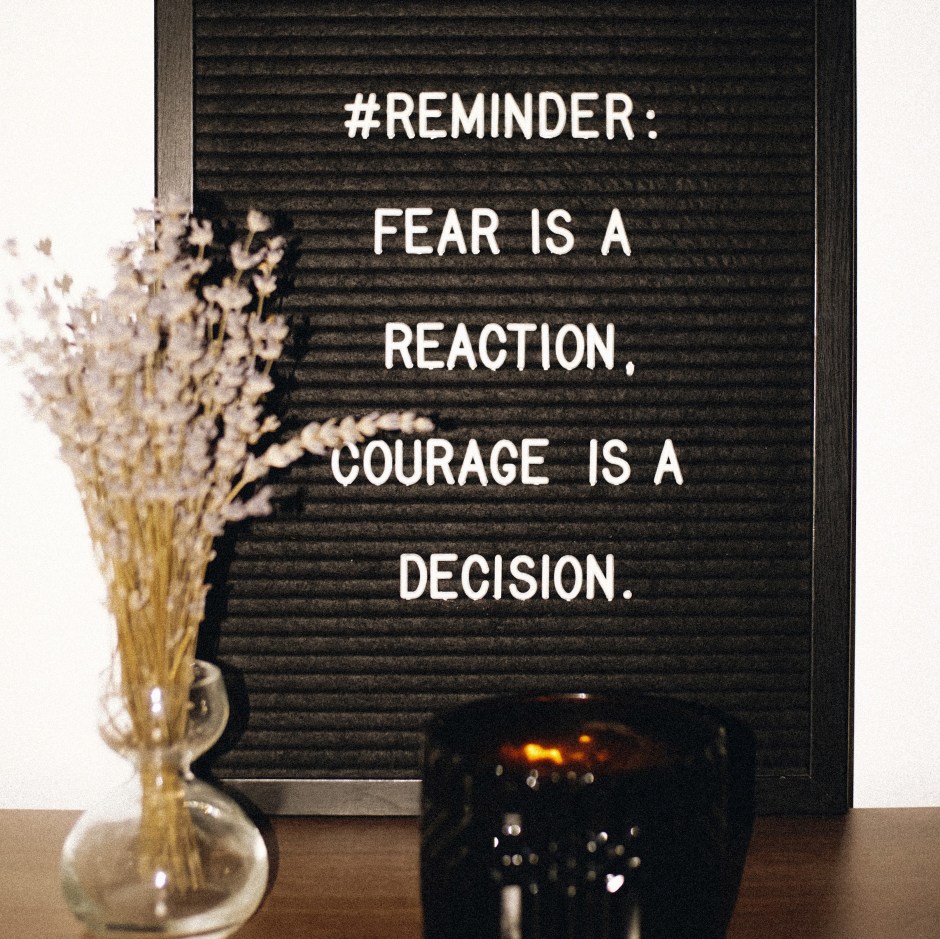
As Winston Churchill said, “Fear is a reaction. Courage is a decision.”

Photo by Cristi Ursea on Unsplash

Creating a Brighter Story for Ourselves

Creativity is the greatest expression of liberty.

~Bryant H. McGill

I still remember the moment when I realized I didn’t have to believe everything I was telling myself. Yes, I had a story, but I didn’t have to stick to it. Not if it was causing me unnecessary pain, keeping me from moving forward, preventing me from opening my eyes to a new and improved perspective on life.

It was a joyous, liberating feeling. I could create a new story that would benefit me and clear away some of the clouds that had obscured the light I needed to transform a painful situation. I acquired an amazing skill that made my life a little easier. Not easy. But brighter, more hopeful.

The stories we tell ourselves are powerful because they affect how we feel and behave. They determine our identity.

In my younger days, when I was feeling unpopular and inept, I made myself miserable by thinking I should have lots of friends and darn it, people should like me. When I changed my beliefs and assured myself that it was okay to have just a few buddies, I reached out to others whose social skills were on par with mine and connected with the interesting characters I found in books.  And that was enough.

Sometimes the unhelpful story we’ve constructed about ourselves is that we can’t do something or that we need to be full of fear. Those thoughts block our positive energy and deplete our personal power. Pulitzer Prize-winning author Alice Walker said, “The most common way people give up their power is by thinking they don’t have any.”

If we suspect that the narrative we’ve developed is harming, not helping us, we can ask ourselves questions like those recommended by Byron Katie in “The Work”:

Is it true?

Are you absolutely sure it’s true?

We can explore further:

How do I feel and behave when I believe that story?

Who would I be without that story?

When we realize that what society, or others, or our own sad self is saying isn’t the final word, we can summon up our courage, compassion, and creativity. We can reframe a chapter or paragraph in our life in a way that will bring peace and inspiration.

Sometimes the tale we are telling ourselves prevents us from moving on from past injustices. One of my favorite forgiveness stories is that of Holocaust survivor Eva Kor, who has been honored as a “Hero of Forgiveness.” For many years the story she told herself was that of victimhood because she was unjustly hurt by Nazis who conducted horrific medical experiments upon her and her twin sister. Members of her family were murdered. Kor had every reason to hate, but she came to this realization:

Hatred is an infectious disease.

She decided the narrative she believed about herself as a powerless victim was prolonging the trauma of her past. Her new story, one of forgiveness, was self-healing and self-empowering. She called forgiveness miracle medicine and said, “It’s free; it works and has no side effects.”

The story we tell ourselves about our pain determines our degree of suffering. When we tell ourselves that a situation can’t change because another person is to blame or we’re not good enough to do something about it, we become weak. When we ruminate obsessively over a past that inevitably remains the same, we are stubbornly refusing to direct our energy toward creating a better future.

Focusing on fault or regret takes us down a detour of defensiveness or shame. It delays our journey to a destination where burdens are lifted, problems are solved, and relationships are mended. One of my favorite anonymous quotes is, “Fix the problem, not the blame.”

When we’re able to control our harmful thoughts,

they lose their power to control us.

Self-control is a virtue encouraged in the major religions along with the goal of “mindfulness.” Being mindful means creating a distance between our thoughts and our identity, realizing our thoughts are not who we are. They are simply thoughts that appear based on a variety of factors such as our instincts, our past, our fears and desires. We can decide what we want to do with our thoughts and create the next chapter in our courageous, compassionate life story.

I’m a writer and it’s important that I edit my work. I go back to early chapters of a book, or paragraphs of a blog, and modify my words so their meaning becomes clearer and more illuminating. As a human being, I can go back to early chapters of my life and reflect on them with grace and the wisdom that experience brings me. I can use my reflections to create new, improved episodes in my life journey.

Creativity isn’t just about art. It’s about the ability to look at a situation from various perspectives and imagine new ways of being. About having the courage to question assumptions and “certainties” that aren’t really certain. About being determined and persistent as we create a story in which we become a person whom we respect.

Thomas Edison created a story that led him to the creation of the first light bulb. He had many unsuccessful attempts at his goal, but that did not deter him. He said, “I have not failed. I’ve just found 10,000 ways that won’t work.”

We will all have struggles in life. What’s important is that we don’t lose hope. That we take what we learn and create stories that brighten our paths and lead us to light.

photo by Nick Fewings on Unsplash