Self-Forgiveness Opens the Door to Forgiving Others

Never be defined by your past. It was just a lesson, not a life sentence.

~Tiny Buddha

Forgiving is for giving. Self-forgiveness can be a life-changing gift we give ourselves that opens the door to forgiving others. If we haven’t experienced compassion and grace ourselves, how can we share it with others?

Forgiving ourselves is hard, and that’s a good thing. We need to feel remorse when we’ve caused pain or injustice. We don’t want to function like sociopaths who have no anxiety or guilt when they harm others. But we need to take on the difficult task of forgiving ourselves so we don’t hide in shame, or even worse, deny our wrongdoing and blame others for our offensive behavior or mistakes.

If we can’t forgive ourselves, we generally journey down one of two destructive paths. I call them The Dead-End Road of Shame and The Abusive Highway of Blame.

Following the Dead-End Road of Shame is different than admitting guilt. Guilt is a motivator that drives us to understand our behavior and decide to do better. Learning from our missteps is productive and allows us to grow and evolve.

Shame, however, means believing we are “bad” and unworthy of forgiveness. We believe our past mistakes and transgressions are fatal and use them as a reason to give up, become stagnant, and isolate ourselves. Shame hurts our relationships. It prevents us from sharing the joy of unconditional grace and the peace that comes with accepting our limitations.

The Abusive Highway of Blame is traveled when we don’t have the courage to own our mistakes and bad behavior. If we fear judgment or punishment because of something we’ve done, finding a way out of our mess that doesn’t involve taking responsibility and admitting wrongdoing may define our journey.   Blaming others is an attempt to stay out of trouble. However, it keeps us from forgiving others because that would mean we have to quit blaming them and become accountable for our actions.

A manipulative tactic sometimes used on the Abusive Highway is what Professor Jennifer Freyd calls DARVO: Deny, Attack, and Reverse Victim and Offender. If we’d rather be right than truthful and are afraid to acknowledge what we’ve done, we may deny, attack, and step into the sinister scenario of accusing those we’ve hurt of being the “real” offenders. We may claim those we’ve offended deserve our abuse or are falsely accusing us of wrongdoing. This strategy is especially harmful when DARVO warriors are attacking vulnerable people who lack the confidence to stand up for themselves.

When DARVO is used politically, it may lead to competitive victimhood. “You started it.” “No, you did.” “It’s your fault.” “No, it’s your fault.” Each side attacks the other self-righteously and protectively. Refusing to listen. Refusing to admit any wrongdoing or mistakes. Refusing to cooperate and collaborate.

Our life journey becomes more joyful and kind when we reject the Dead-End Road of Shame and the Abusive Highway of Blame and choose instead to follow the Path of Forgiveness. We replace shame and blame with courage and compassion and create a new story in which we move forward with honesty and integrity. We reclaim our dignity.

The foundation of forgiveness is acceptance of the messiness of the human condition. Forgiveness is built on the knowledge that we normal, imperfect humans must learn through struggle and errors.

Bad behavior doesn’t mean we’re bad people. We can learn and grow by understanding why our actions failed or were hurtful. We can figure out how to do better in the future. Only when we know better will we be able to do better.  

The ability to forgive ourselves for our human deficiencies frees us from an overemphasis on perfection and allows us to enjoy discovery and innovation. Jonathan Biss, concert pianist, wrote an opinion piece for the NY Times lamenting that classical musicians are trained to prevent mistakes, but they aren’t trained to talk to God. He explained, “You cannot learn or grow while trying to appear as if you have everything figured out. You cannot talk to God by trying to avoid doing something wrong.”

In other words, if we’re afraid to listen to our inner, spiritual voice because we fear messing up, we will miss out on magical moments and creative breakthroughs. Unrealistic expectations and a quest for perfection may imprison us and block the excitement and curiosity that naturally occur when we’re embracing the pleasures of learning and finding joy in the mysteries of life. 

Beatrice Wood, American artist and studio potter, said “My life is full of mistakes. They’re like pebbles that make a good road.” Pebbles are the aggregate that makes roads resilient. Mistakes can do the same for us.

The roads we follow are unique. Sometimes pebbles feel more like boulders that are impossible to move. All our journeys contain regrets, grief, and sadness. We struggle with darkness, but the good news is we can replace it with light and build something new. That’s what the forgiveness process is all about.

Self-forgiveness is not about pardoning ourselves or anyone else for wrongdoing, and it’s not about forgetting what happened. It’s the opposite. It’s about accepting imperfection, stepping on our pride, and taking responsibility for our feelings and actions. It’s about dropping facades and opening our hearts to love fully. It’s about resilience, because we’re not afraid to try new things, reach out to others, and evolve.

The path of forgiveness leads to transformation and becoming our genuine selves. When we do that, we have nothing to hide and no one to blame.

Give yourself the gift of forgiveness. And be sure to pass on the joy and peace it brings you to others.

Photo by Harli Marten on Unsplash

The Joy of Love Is My Strength

The large, fluffy white dog was so patient, staying close to his elderly friend who walked very slowly with the help of a cane. He was joined by a woman, who also stayed close by his side. The man, whom I’d greeted for many years on my own walks, used to stride unaided at a fast clip. I understood. Walking a beloved dog through a beautiful park is pure joy and not something you give up just because your body complains of aches and pains.

The scene I observed that morning raised my spirit and brightened my mood, which was rather sour after reading news headlines proclaiming terrible things we humans do to each other. As I drove by, the song “The Joy of the Lord Is My Strength,” played on the radio. My mind quickly transformed the words to “The Joy of Love Is My Strength.”  I envision God as the Spirit of love, not a lord or king. Acts of loving kindness strengthen my faith and give me hope.

Later that day I was listening to a news podcast interviewing Christian nationalists and quoting Elon Musk, who has said that “the fundamental weakness of Western civilization is empathy.” They discussed what Joe Rigney, a fellow of theology at New St. Andrews College, has called “the sin of empathy.”  This was the first I’d heard about the idea that empathy could be wicked.

I learned that those who consider empathy as something that can be taken to a sinful extreme believe that when we immerse ourselves in the feelings of others we lose our ability to rationally consider what’s truly good for them. We may abandon our beliefs and judgments when committing the sin of empathy.

So what is empathy?

The Merriam Webster Dictionary defines empathy as “the action of understanding, being aware of, being sensitive to, and vicariously experiencing the feelings, thoughts, and experience of another.”

Understanding, awareness, and sensitivity do affect our thinking. If I can’t feel empathy for others’ suffering, I may make choices that benefit me and my group only. If I refuse to try to understand the feelings, thoughts, and experiences of others, it will be easy for me to make cruel, unfair decisions concerning them. If I’m not sensitive to the needs of someone whose land or resources I want to take, my conscience can be clear, moral integrity intact. That’s why attempts are made to desensitize soldiers to killing before we send them off to break one of the Ten Commandments.

Those interviewed were especially concerned about how empathy affects people’s thinking about immigrants, the LGBTQ+ population, and others who may be suffering. They warned that empathy can lead to excessive compassion and the fear is, instead of helping those who are suffering, we will instead fall into a pit with them. They warned we must not get caught up in feelings (I assume strong feelings against empathy are okay) but instead hold fast to our beliefs and judgments so we can do good.

One of my beliefs is that empathy is important and the podcast made me even more convinced that engaging in empathy is valuable to decision making. Being sensitive to the feelings and experiences of people in the LGBTQ+ community has helped me eliminate fears that could cloud my thinking. Time spent with English language learners has provided me with a better understanding of why people enter the United States and how they benefit our communities. Truly listening to people with different needs and perspectives from my own has expanded my awareness. I would feel “sinful” if I judged people I hadn’t taken the time to understand. 

Forgiveness requires empathy. The Sacred Lakota Pipe Carrier I interviewed regarding forgiveness realized lack of knowledge regarding American Indians led to prejudice and injustice. She didn’t like being judged by people who didn’t understand her and didn’t want to become like them. She said, “Nobody is going to make me hate.”  

Without enough empathy we get caught up in condemning others and proving our side – our people – are the right ones, the superior ones. The “others” are a scapegoat for our problems and a foe to defeat. The value of cooperation and collaboration are forgotten as we battle to win or lose, not to reach a wise decision that considers all perspectives.

Have you ever been told you’re too nice? I’ve found being too nice means going along with someone or something so I don’t suffer. It’s easier to say “yes” than argue with someone. We don’t want to make people mad, lose a friendship or job. So we go along to get along. Empathy makes it harder for us to go along with cruel, unfair actions.

Bleeding heart and do-gooder are terms that may indicate we’re trying to make ourselves feel good by doing good to others. Nothing wrong with that. However, without empathy, we may not truly understand another’s needs. The danger is we may make people feel incompetent or helpless, increasing their dependence on us for our own gain instead of providing them with dignity and opportunity.

Empathy helps us understand what someone needs and what they don’t need. It keeps us from judging people we don’t know by anything other than a label.

In an “us versus them” world, we may believe a powerful, harsh lord or king is needed to protect us. But the joy of the Lord, as described in the Bible under chapters 8 and 9 of Nehemiah, is delight in a loving God that is forgiving, gracious, and compassionate. It sounds like an empathetic God to me.

When I’m not feeling kind and loving, I’m not joyful nor am I strong. I’m weak because I’m wrapped up in my own ego and personal expectations. My heart and mind are closed for business because I’m too busy being angry and self-righteous. I’ve no energy for empathy because fear and anxiety have depleted me.

The woman and the dog who walked beside the man in the park understood what he needed and respected his dignity. They walked beside him, sharing in his love of nature, fresh air, exercise. They were sensitive to his feelings. That’s empathy. That’s the joy of a loving spirit that is our strength.

Forgiveness – Bridging Deep Divides

I was a guest, along with Kenneth Cloke, on Humanity Rising’s program exploring the power of forgiveness and civil discourse in bridging deep divides. Below you will find an explanation of our conversation and a link to the program.

Blessings,

Favorite Forgiveness Quotes

Forgive yourself, you are not perfect.

Show yourself grace; you are still learning.

Show yourself patience; you are on a journey.

~Shannon Yvetter Tanner, Life-Empowerment Coach

Self-compassion gives us the courage to face our inadequacies and failures with kindness. It empowers us to move forward without the fear of not being good enough. When we accept ourselves as we are – perfectly imperfect humans with strengths and weaknesses – we experience the beauty of grace.

Favorite Forgiveness Quotes

When tempted to judge and condemn,

Choose instead curiosity.

When tempted to hate and despise,

Choose instead compassion.

When we choose forgiveness, we make the decision to conquer our pride and our need to be right. We choose a path that requires effort, but that is oh, so very worth it. Curiosity and compassion allow us to view our problems from a wiser, kinder perspective.

Favorite Forgiveness Quotes

There is some good in the worst of us and some evil in the best of us.

When we discover this, we are less prone to hate our enemies.

~ Martin Luther King Jr.

It’s very easy to demonize people who hurt us and look at them as objects that cause harm, not imperfect humans who are hurting like us. We may put people in good and bad boxes, refusing to let them out, and ignore Bible verses like Luke 6:27 that say “Love your enemies, do good to those who hate you.” Remembering that we all struggle helps us forgive both others and ourselves.

Favorite Forgiveness Quotes

Do the best you can until you know better. Then when you know better, do better.

~Maya Angelou

We’re all doing the best we can and we’re all on different paths to growth. Let’s be gentle with each other. We cannot do what we have not yet learned. Understanding comes with time and experience. Keep learning.

Self-Forgiveness Prayer

“The Other Serenity Prayer” by Eleanor Brown

God grant me the serenity to stop beating myself up for not doing things perfectly,

The courage to forgive myself because I’m working on doing things better,

And the wisdom to know that you already love me just the way I am.

Self-forgiveness can be harder than forgiving others. When we accept our own strengths and weaknesses, we are more able to extend compassion to others. Letting go of the idea that we should be perfect and not make mistakes gives us the freedom we need to learn and grow.

Humility Is a Superpower

We come nearest to the great when we are great in humility.

~ Rabindranath Tagore (Bengali writer awarded a Nobel prize in literature)

“You don’t understand. Arabs aren’t like us. Their mothers don’t care for their children like ours do. Their leaders don’t protect them like ours do.” I was on a plane returning to the USA from a United Methodist Mission trip to Israel and the Palestinian West Bank. My seat happened to be in the middle of two Jewish Israeli citizens and I listened to the two men describe their fears and beliefs about Palestinian Arabs.

I’d had the opportunity to visit with a variety of people on my trip. People who identified as Jewish, Christian, and Muslim; Israeli and Palestinian Arabs. Our conversations centered around peace and justice, and I think they all had mothers who loved them dearly. I didn’t talk to members of Hamas. If I had, I would likely have heard remarks about Israelis similar to the ones I heard from my seatmates about Arabs.

I shared with my new Israeli companions that I’d met many wonderful people of different faiths and ethnicities during my travels. They weren’t impressed. “Of course, there’s a few good ones,” one responded, and the other nodded agreement.

I understood the men’s fear. Antisemitism has been and continues to be a real threat to peace and safety. But so is anti-Arab sentiment, anti-Muslim, anti-Palestinian, anti-Christian, and the list goes on and on. Our instincts tell us it’s “us against them.” But all the military might – the weapons, bombs, and drones that allow us to kill people we don’t know but somehow still hate – won’t bring real peace or safety. Wars create bitterness. Violence and oppression produce rage and terrorism.

I told my airline seatmates that I studied and taught about the wisdom (not the politics) of the world’s major religions and felt there was beauty and much for us imperfect humans to learn in all of them. They were skeptical. I get it. We humans are programmed to be fearful. We defend ourselves against people who we believe don’t think or act like we do. That’s what helps us survive.

Until it doesn’t.

Human history is full of war and violence. The idea that we need to fiercely fight an enemy for our freedoms seems firmly entrenched in our psyche. Our belief in the efficacy and necessity of war has not changed over the centuries. But technological advancements in the weapons of war have made the destruction of the human species a real possibility. We need to put forth a powerful effort to solve our conflicts differently.

That’s where the superpower of humility comes in. The major religions promote humility. Not as a weakness. Just the opposite. As a strength. The superpower of humility means we’re able to overcome our fears and have the confidence and self-control necessary to listen to those who challenge us, hurt us, and make us oh, so mad. Those whom we don’t understand – but we could if we put forth the effort.

Humility isn’t easy. It’s hard to hear ideas we believe are harmful. It’s hard to listen to people we fear will hurt us. But if we don’t listen, we won’t understand. And if we don’t understand, we’ll fix the blame instead of fixing the problem. We’ll keep fighting or fleeing when faced with tough situations and never resolve core issues.

When I returned from my travels to Israel and Palestine, I joined the Jewish Voice for Peace, a group which believes that ending apartheid in Israel and condemning all racism, not just antisemitism, is the way to keep Israel and the Jewish people safe. They  “envision a world where all people — from the U.S. to Palestine — live in freedom, justice, equality, and dignity.”

Christianity’s Jesus gave us a tough message. He said, “Love your enemies and pray for those who persecute you.” Those words were meant to protect us and help us look upon each other with compassion and empathy so we could solve conflicts without harming each other. So clouds of misunderstanding could be lifted and we could communicate with respect.

When we respect the dignity of others and they respect us, fear diminishes. Our rational brain kicks in and finds a way to create solutions that don’t harden our hearts and destroy our souls. We produce answers that don’t rely on death and devastation; that don’t create a cycle of revenge.

On a personal level, humility is a superpower that brings us peace of mind. We let go of the fear we are not good enough, or the desire to be better than others, and can just be our unique selves. We can fail and make mistakes without beating up on ourselves, because we accept the fact that we are only human and doing the best we can.

 A favorite Bible verse of mine is Micah 6:8 because it answers a question many of us have: How should we live our lives? The advice given is simply to act justly, love mercy, and walk humbly with your God.  

When we walk humbly with our God, we seek justice and we defend ourselves. But we do so with grace and compassion, knowing we all struggle and are always learning. Knowing that when we hurt another, we hurt ourselves.

When we listen well and extend dignity to all, we will be blessed with new insights, innovative ideas, and unexpected friendships. Humility is the superpower that enables peace in our personal lives and in our world. It’s what makes us great.

Photo by Vicky Sim at Unsplash

Who Are You Allergic To?

“If you take sulfa again, you will die.” That was the prognosis after the sulfa prescribed for my infection caused me to become ill and break out in hives that stretched from my head to the bottom of my feet.  It was my introduction into the dangers of allergies.

Allergies occur when our immune system identifies a certain substance as harmful, even though it isn’t. Apparently, the decision-making cells in my immune system mistakenly decided the foreigner sulfa was dangerous, so warrior cells were ordered to attack. Unfortunately, sending the troops into battle caused more harm than good. Nevertheless, in the future, my immune system will stubbornly continue to believe sulfa is a dangerous enemy. That fear, not the sulfa itself, will be what could kill me.   

It amazes me that our immune system has the same problem with fear that our brain does. When we overreact to perceived danger, we cause ourselves needless stress resulting in a variety of negative consequences: high blood pressure, anxiety disorders, insomnia, paranoia, damaged relationships – and on a broader scale – terrorism and war.

Perhaps it should come as no surprise that fear and overreaction are common themes affecting both our immune system and our limbic system (the part of the brain involved in our behavioral and emotional responses). After all, a significant challenge in life is assessing risks and creating balanced responses. Antibodies protect us against bacteria, viruses, and infections, but our immune system finds it hard to identify a real threat and react appropriately every time. Our limbic system also suffers from imperfection. It’s designed to protect us from danger, but we don’t always assess a situation accurately. Overreacting shuts down rational, higher-order thinking.

To complicate things further, overreacting to fear creates unhealthy responses that fuel more fears. Admitting we incorrectly responded may hurt our pride and make us fear vulnerability, so we cling to our “allergies.” What a vicious cycle it can be!

Taking control of our worries isn’t easy because one of our primary concerns is, naturally, our safety and survival. We develop “allergies” to each other because we fear being hurt and losing power, control, or resources. Unfortunately, those allergies will end up harming us if we don’t mount a rational counteroffensive.

Fear can lie to us. We need to have a conversation with our fears because they will demand to be heard and acknowledging them can be an insightful experience. But we don’t want them to scream at us and manipulate us into doing something stupid. And we don’t want them to keep us from learning and growing wiser. Seeking a compassionate, balanced discussion with our fears prevents them from moving in and creating allergies.

For example, it seems there are a plethora of politicians and media outlets that want me to fear immigrants and people from foreign countries. If I had let those voices create “allergies” within me, I would have missed out on tutoring English language learners from various countries and I wouldn’t have ventured to Kenya, Palestine, Nicaragua, Lithuania, and Peru on mission trips. My fears may have kept me safe, but they wouldn’t have opened my mind and heart to illuminating new understandings.

Being brave and courageous is a formidable task – at least it is for me – but I don’t want fear to steal my happiness or my integrity. I don’t want to develop the equivalent of an autoimmune disease.

Autoimmune diseases occur when our immune cells attack our own body by mistake. When I become hateful, jealous, greedy, dishonest (or any other adjective indicating a breakdown in my morals), I am attacking my own character. I need to keep my spiritual self healthy so I can fight off transgressions that tempt me because I’m afraid. Gandhi said, “The enemy is fear. We think it is hate; but, it is fear.”

The virtue of forgiveness is impossible to genuinely pursue when we are fearful. We can’t let go of a painful event if we are frightened that it will occur in the future. If I’m hurt by someone and don’t know how to prevent that pain going forward, I will hold onto it until I understand it and can figure out how to reduce it. If I don’t trust myself, I need to determine how to regain self-respect, so I don’t keep torturing myself with shame and regret.   

Actress Betty White said, “You don’t luck into integrity. You work at it.” We have to work at virtues, just like we work at a healthy diet or skill building. The potential is there, but we fool ourselves if we believe integrity develops without effort and a generous dose of humility.

We use our rational brain to fight fear and hate, but we’re also going to need love – love for all humankind, including ourselves. The Roman poet Virgil, around 37 BCE wrote in “Eclogues” that, “Love conquers all; let us surrender to love.” The Bible, 1 John 4:18, counsels us that, “Perfect love casts out fear.” Contemporary author Lorin Morgan-Richards wrote, “Love conquers the temporary hold of fear and hate. Inhumanity is a loop without it.” Throughout the ages, we’ve been advised to love one another, not fear one another.

A love for humankind, also known as agape love, is what unites and heals us. But human history testifies to how difficult it is to embrace. It requires compassion, which I think of as empathy with action. We not only strive to take the perspective and feel the emotions of another, we desire to let that understanding guide us.

When I’m fearful, I’m imprisoned in my own ego because I erect a wall that keeps out compassion. Shifting my perspective allows me to conquer my fear. For example, I was angry with someone recently because, in my mind, they were being arrogant and disrespectful to me. Whether they were or were not wasn’t the issue in my response. I reminded myself their behavior was a reflection on them, not me. Then I chose to be compassionate and consider what they were fearing – what their struggle was – and planned my response accordingly. The outcome was far better than had I given in to the allergy I was forming.

My fear sometimes stems from a lack of compassion for myself. I worry I will say or do something wrong. If I remind myself that it’s okay to say or do something that doesn’t meet expectations, I can relax, show myself self-love, and prevent my fears from harming me.

Autoimmune diseases are caused by a combination of genetics and environment. The same is true about our behaviors. Genetics provides us with a system that allows us to protect and defend ourselves and we can be grateful for that. But we can be especially thankful that we have it in our power to control our fears.

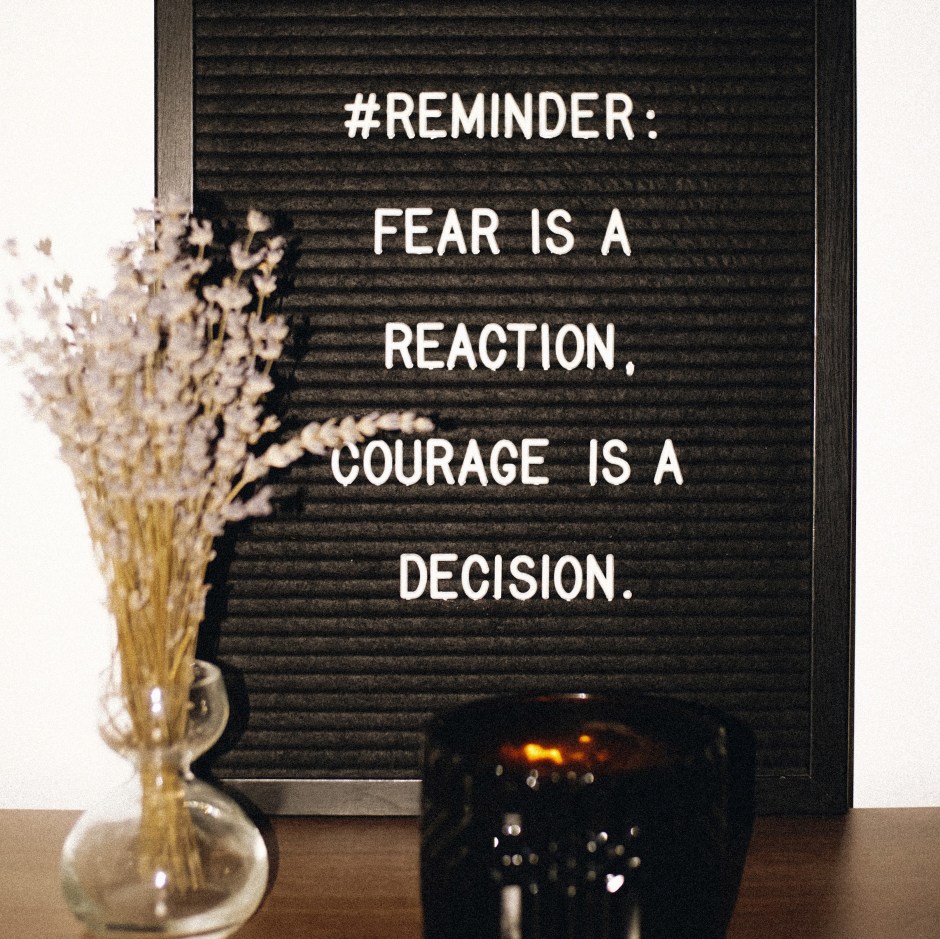
As Winston Churchill said, “Fear is a reaction. Courage is a decision.”

Photo by Cristi Ursea on Unsplash